Season 3, Episode 4
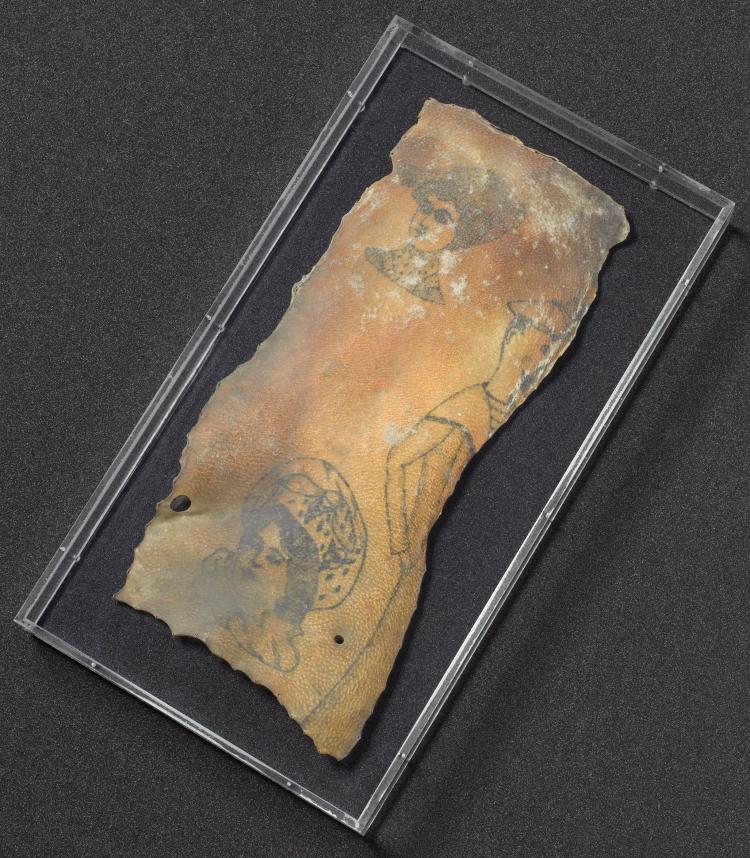
‘Human skin with tattoos of two women’s heads and a sailor’, French (1880–1920), Wellcome Museum Collection (The Science Museum, London) 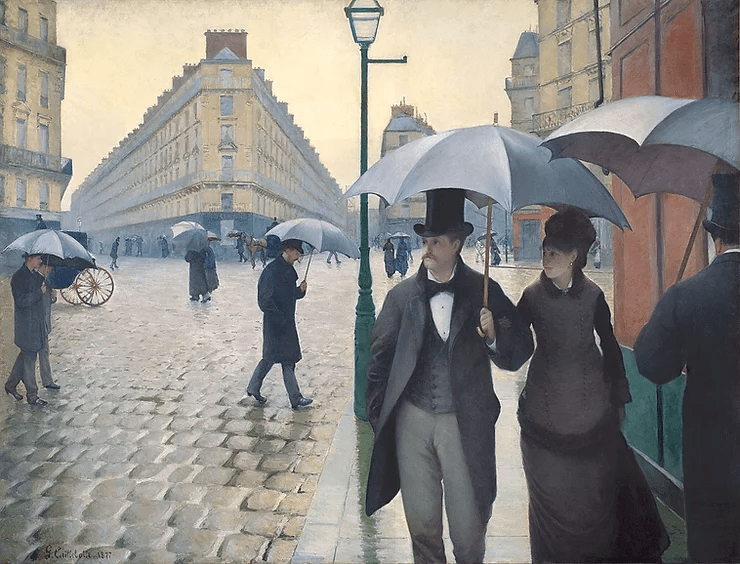
Gustave Caillebotte, ‘Rue de Paris, temps de pluie’ (1877) 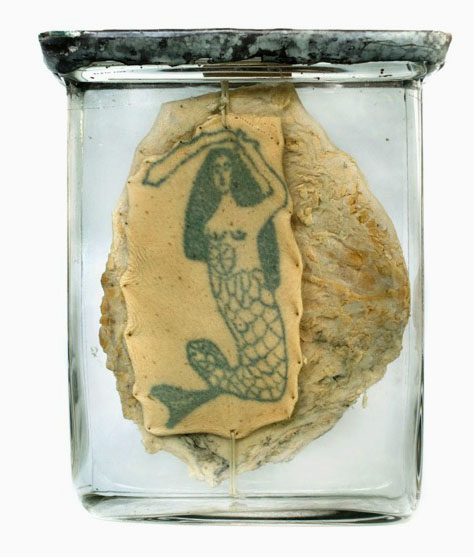
[WE CAN’T SHOW YOU THE IMAGE WE ACTUALLY TALKED ABOUT, SO HERE IS A SIMILAR ONE] Human skin with tattoo of a mermaid, Polish (late 19th–early 20th century), photographed by Katarzyna Mirczak (2010). You can find the specimen we actually talked about in Matt Lodder’s article ‘Things of the Sea’ (2015), cited below, fig. 11, p. 206 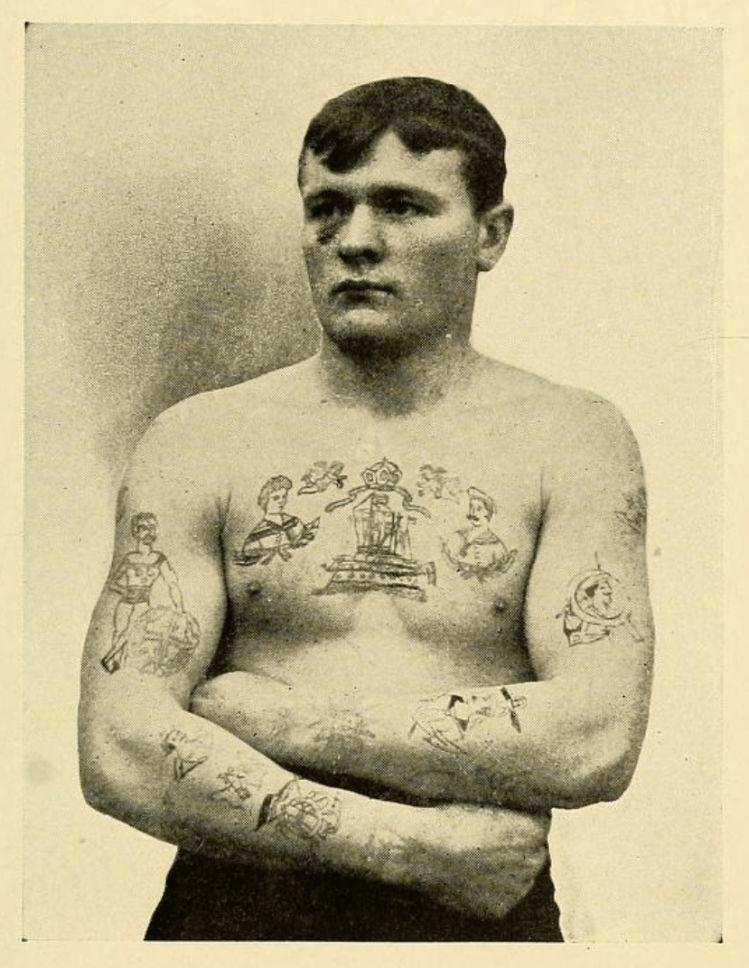
Photograph of a man with tattoos and a black eye (late 19th century), published in Lombroso, ‘Criminal Man’ (1911) 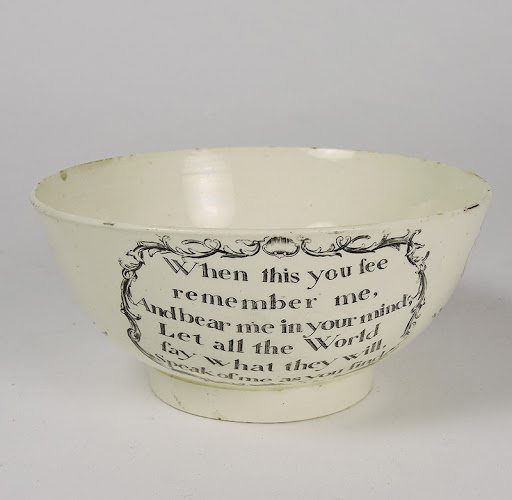
Staffordshire cream-ware bowl with inscription (late 18th century) 
Ötzi the Ice Man (c. 3230 BCE) and his tattoos, from Krutak, ‘Therapeutic Tattooing in the Arctic’ (2019) 
Hand-coloured print of Maori facial tattoos, from Cook’s first voyage to New Zealand , by Sydney Parkinson(1769) 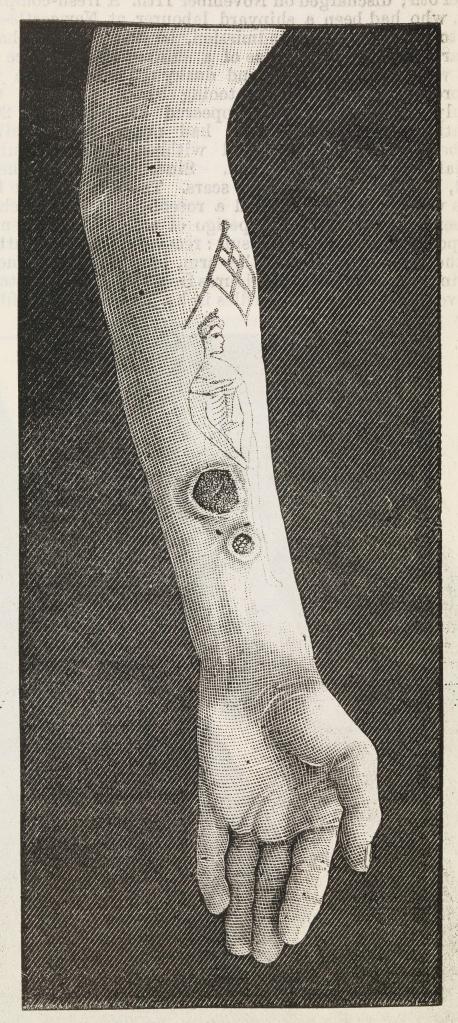
Print showing signs signs of syphilis on the site of a tattoo, from ‘Notes of Cases on an Outbreak of Syphilis following on Tattooing’, (1889) 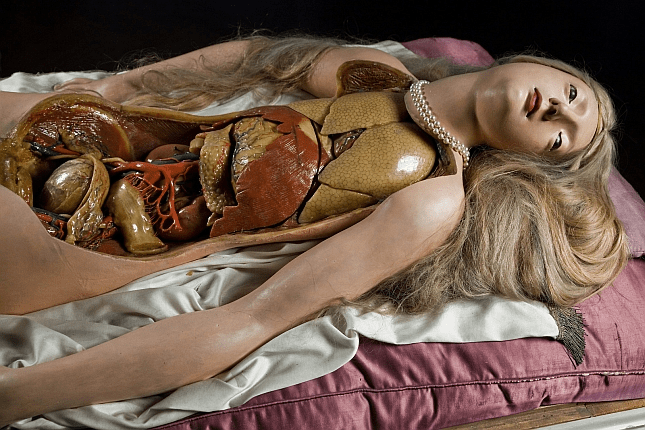
Wax anatomical venus, Josephinum Museum of the Medical University of Vienna (late 18th century) 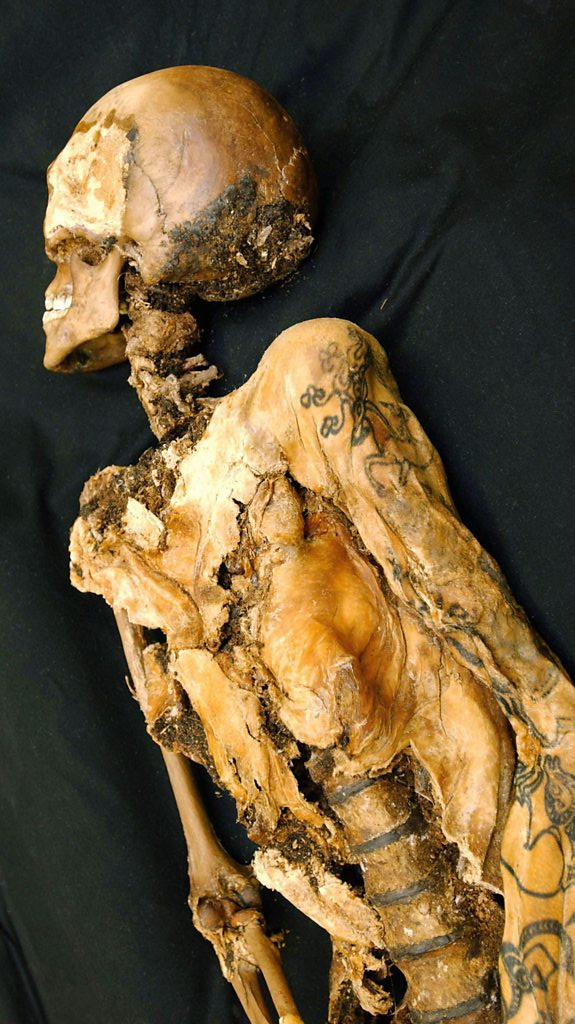
Siberian Princess of Ukok with shoulder and arm tattoos (5th century BCE) 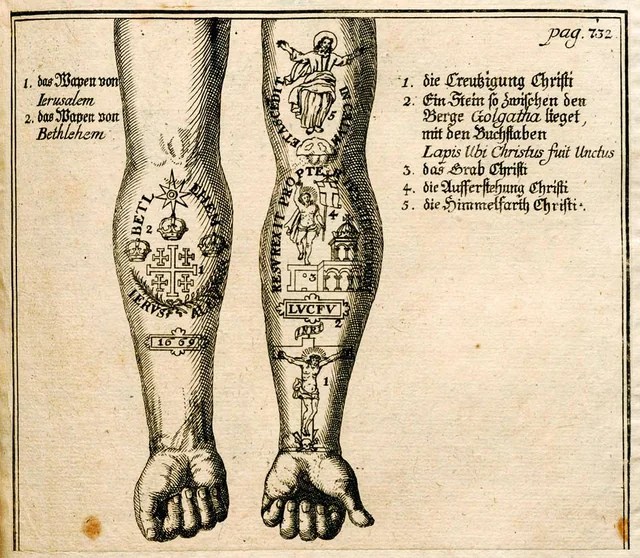
Pilgrim tattoos of the Arms of Jerusalem (c. 1669), German 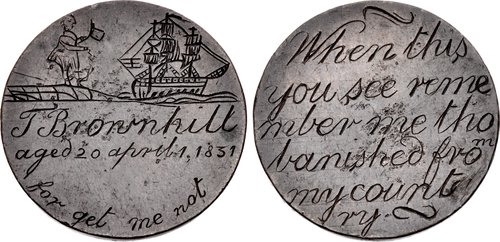
Example of material culture with iconography similar to contemporaneous tattoos: Convict love token, ‘When you se this, remember me’ (c. 1831-1832) 
Tattoos by Sutherland Macdonald (late 19th century) 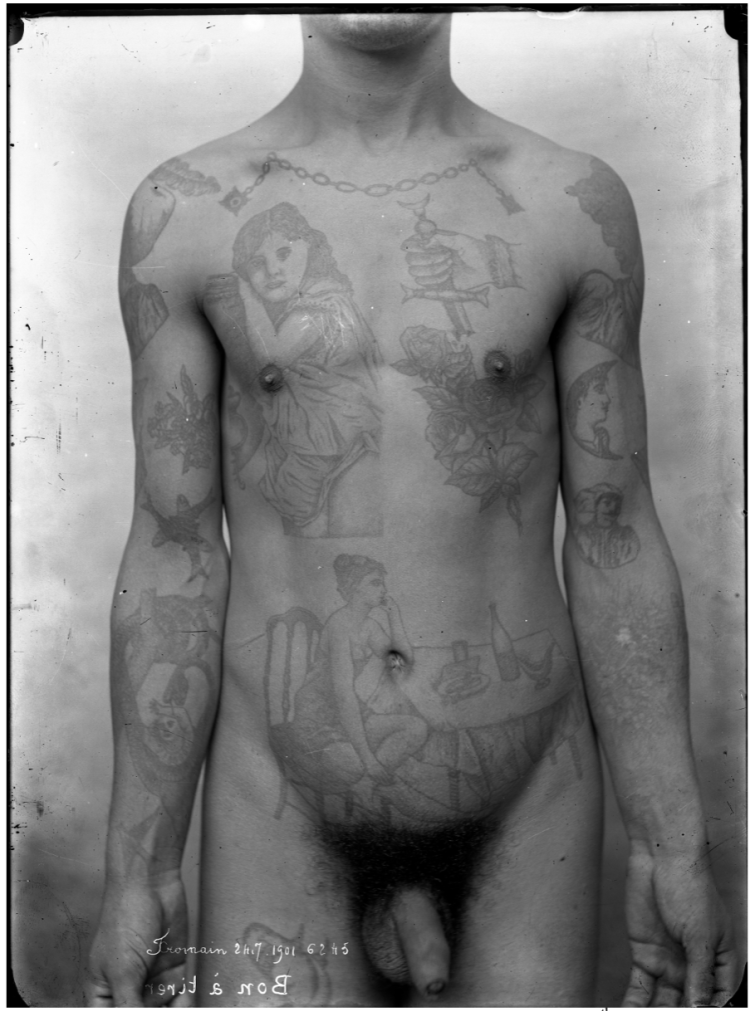
Photograph of ‘Fromain’ (1901), Archives de la préfecture de police, Paris, published in Angel, ‘Roses and Daggers’ (2015) 
Drawing from Lombroso archives of the tattooed body of incarcerated person Francesco Spiteri, with labels describing and categorising his tattoos (1889) 
Dried human skin specimen from the body of ‘Fromain’, published in Angel, ‘Roses and Daggers’ (2015) 
‘Ridge’s Patent Cooked Food’ advertisement from ‘The Sketch’ (1893), published in Angel, ‘Roses and Daggers’
listen on Spotify
listen on Apple Podcasts
Emma and Christy present a brief history of tattooing in Europe. We talk tattoos as art history; sailors and soldiers; the archival (in)visibility of tattoos; the ‘Cook myth’, colonial contact, and contagion; syphilitic tattoos and pathologisation; working class bodies; tattoos and material culture; criminal anthropology; pain; the skin ego; danger and deviance; the limits of interpretation and (il)legibility of signs; ‘fugitive’ images; pilgrim tattoos; and art histories from below.
MEDIA DISCUSSED
Human skin with tattoos of two women’s heads and a sailor, French (1880–1920), Wellcome Collection / Science Museum
Gustave Caillebotte, Rue de Paris, temps de pluie (1877)
Human skin with tattoo of a mermaid, Polish (late 19th–early 20th century), photographed by Katarzyna Mirczak (2010). For the exact specimen we discuss see Lodder, ‘Things of the Sea’ (2015), fig. 11.
Photograph showing a man with tattoos and a black eye (late 19th–early 20th century), published in Lombroso, Criminal Man (1911)
Staffordshire cream-ware bowl with inscription ‘When this you see,/ remember me / And bear me in your mind / Let all the world,/ say what they will,/ Speak of me as you find’, (late 18th century)
Diagram showing Ötzi the Ice Man’s tattoos (c. 3230 BCE), from Krutak, ‘Therapeutic Tattooing in the Arctic’ (2019)
Sydney Parkinson (the artist on Captain Cook’s first voyage to New Zealand), portrait of a Maori man with facial tattoos (1769)
Print showing signs signs of syphilis on the site of a tattoo (1889), from ‘Notes of Cases on an Outbreak of Syphilis following on Tattooing’ (1889)
Wax anatomical venus, Josephinum Museum of the Medical University of Vienna (late 18th century)
Princess of Ukok (Siberia), with tattoos (5th century BCE)
Print of the pilgrim tattoo of Ratge(r) Stubbe (c. 1669), showing Arms of Jerusalem tattoo
Example of material culture with iconography similar to contemporaneous tattoos: Convict love token, ‘When this you see, remember me’ (c. 1831-1832)
Tattoos by Sutherland Macdonald (late 19th century)
Photograph of incarcerated person known as ‘Fromain’ (1901), Archives de la préfecture de police, Paris, published in Angel, ‘Roses & Daggers’ (2015)
Drawing from Lombroso archives of the tattooed body of incarcerated person Francesco Spiteri, with labels describing and categorising his tattoos (1889), Museum of Criminal Anthropology, University of Turin
Dried human skin specimen from the body of ‘Fromain’ (late 19th century), Wellcome Collection / Science Museum, published in Angel, ‘Roses & Daggers’ (2015)
REFERENCES
‘Mary Ann Brennan’ (b. 1826), record from the Digital Panopticon project
Matt Lodder, ‘“Things of the sea”: Iconographic Continuities between Tattooing and Handicrafts in Georgian-Era Maritime Culture’, The Sculpture Journal 24.2 (2015): 195–210
Our Andy Warhol episode
Matt Lodder, ‘A Medium, Not a Phenomenon: An Argument for an Art-Historical Approach to Western Tattooing’, in Tattooed Bodies: Theorizing Body Inscription Across Disciplines and Cultures, ed. by James Martell and Erik Larsen (Cham, Switzerland: Palgrave Macmillan, 2022), pp. 13–42
Gemma Angel, ‘The Tattoo Collectors: Inscribing Criminality in Nineteenth-Century France’, Bildwelten Des Wissens 9.1 (2012): 29–38
Gemma Angel, ‘Recovering the Nineteenth-Century European Tattoo: Collections, Contexts, and Techniques’, in Ancient Ink: The Archaeology of Tattooing (University of Washington Press, 2017), pp. 107–129
F. R. Barker, “Notes of Cases on an Outbreak of Syphilis Following on Tattooing,” The British Medical Journal (May 4, 1889): 975-988.
Gemma Angel, ‘Atavistic Marks and Risky Practices: The Tattoo in Medico-Legal Debate, 1850-1950’, in Jonathan Reinarz and Kevin Siena, eds., A Medical History of Skin: Scratching the Surface, pp. 165-180(London: Pickering & Chatto, 2013).
Jane Caplan, ‘Introduction’, in Written on the Body: The Tattoo in European and American History, ed. by Jane Caplan (Princeton: Princeton University Press, 2000), pp. xi–xxiv
Zoe Alker and Robert Shoemaker, ‘Convicts and the Cultural Significance of Tattooing in Nineteenth-Century Britain’, in Journal of British Studies 61.4 (2022): 835–62
Cesare Lombroso and Gina Lombroso Ferrero, Criminal Man, According to the Classification of Cesare Lombroso (New York: G. P. Putnam’s Sons, 1911)
Gemma Angel, ‘Roses & Daggers: Expressions of Emotional Pain and Devotion in Ninteenth-Century Tattoos’, in Probing the Skin: Cultural Representations of Our Contact Zone, ed. by Caroline Rosenthal and Dirk Vanderbeke (Newcastle: Cambridge Scholars Publishing, 2015), pp. 211–38
Didier Anzieu, The Skin Ego, trans. Naomi Segal (London: Taylor & Francis, 2014 [1987])
FURTHER READING
Zoe Alker, ‘Data Mining Convict Tattoos, 1788–1925’, IHR Digital History Seminar (2020)
Zoe Alker (with Robert Schoemaker), ‘Convict Tattoos’, on site ‘Digital Panopticon’ (c. 2020)
Zoe Alker and Robert Shoemaker, ‘How Tattoos Became Fashionable in Victorian England’, The Conversation (2019)
Gemma Angel, ‘In the Skin: An Ethnographic-Historical Approach to a Museum Collection of Preserved Tattoos’, Unpublished PhD Thesis (University College London, 2013)
Gemma Angel, ‘The Modified Body: The Nineteenth-Century Tattoo as Fugitive Stigmata’, Victorian Review 42.1 (2016): 14–20
Caroline Arscott, ‘Morris: The Primitive’, in William Morris and Edward Burne-Jones: Interlacings (London and New Haven: Yale University Press, 2008), pp. 127–49
James Bradley, ‘Body Commodification? Class and Tattoos in Victorian Britain’, in Written on the Body: The Tattoo in European and American History, ed. by Jane Caplan (Princeton: Princeton University Press, 2000), pp. 136–155
Cristina Cilli et al., ‘The Collection of Tattoos of the Museum of Criminal Anthropology “Cesare Lombroso” and of the Museum of Human Anatomy, University of Turin (Italy)’, in The Oxford Handbook of the Archaeology and Anthropology of Body Modification, ed. by Francesco d’Errico and Franz Manni (Oxford: Oxford Academic, 2024), n.p.
Richard Dibon-Smith, ‘The Pictish Tattoo: Origins of a Myth’, in New Ideas About the Past: Seven Essays in Cultural History, ed. by Lynn Hunt (Berkeley and Los Angeles: University of California Press, 1989), pp. 91–102
Karly Etz, ‘Tattooed Cartographies and the Displaced Body in an Age of Political Conflict,’ in Traveling Bodies: Interdisciplinary Perspectives on Traveling as an Embodied Practice, ed. by Nicole Maruo-Schröder, Sarah Schäfer-Althaus, and Uta Schaffers (London: Routledge, 2023)
Anna Friedman, ‘Custom Tattoo Work: Historical Improvisation during William Lithgow’s 1612 Pilgrimage’, on the Tattoo Historian Blog (2016)
Anna Friedman (ed.), World Atlas of Tattoo (London: Yale University Press, 2015)
Harriet Guest, ‘Curiously Marked: Tattooing and Gender Difference in Eighteenth-century British Perceptions of the South Pacific’, in Painting and the Politics of Culture: New Essays on British Art, 1700–1850, ed. by John Barrell (Oxford: Oxford University Press, 1992), pp. 101–34
Lars Krutak, ‘Therapeutic Tattooing in the Arctic: Ethnographic, Archaeological, and Ontological Frameworks of Analysis’, in International Journal of Paleopathology, 25 (2019): 99–109
Matt Lodder, Painted People: Humanity in 21 Tattoos (London: Harper Collins, 2022)
Matt Lodder, Tattoos: The Untold History of a Modern Art (New Haven: Yale University Press, forthcoming)
Margot Mifflin, Bodies of Subversion: A Secret History of Women and Tattoo (New York: PowerHouse Books, 2013)
Nicholas Thomas, Anna Cole, and Brownwen Douglas, eds., Tattoo: Bodies, Art, and Exchange in the Pacific and the West (Durham: Duke University Press, 2005).
Caroline Rosenthal and Dirk Vanderbeke (eds), Probing the Skin: Cultural Representations of Our Contact Zone (Newcastle: Cambridge Scholars Publishing, 2015)
Beverly Yuen Thompson, Covered in Ink: Tattoos, Women, and the Politics of the Body (New York: New York University Press), 2015
Follow our Twitter @drawingblood_
Follow our Blue Sky @drawingbloodpod.bsky.social
‘Drawing Blood’ cover art © Emma Merkling, image courtesy of the British Association of Plastic, Reconstructive, and Aesthetic Surgeons
All audio content © Emma Merkling and Christy Slobogin
Intro music: ‘There Will Be Blood’ by Kim Petras, © BunHead Records 2019. We’re still trying to get hold of permissions for this song – Kim Petras text us back!!
 Drawing Blood Podcast


